Family Law is one of the most important areas of legal practice because it directly governs some of the most personal and sensitive aspects of life. It deals with relationships between spouses, parents, and children, and provides a structured legal system for resolving disputes that arise when these relationships change or break down. Whether it involves divorce, child custody, spousal support, or property division, family law ensures that legal rights are protected and decisions are made fairly under established legal principles.
Understanding your rights in family-related legal matters is essential when dealing with separation or any domestic dispute, and seeking guidance from a family lawyer can help ensure you navigate complex legal procedures with confidence. Without proper legal support, individuals often face difficulties that may seriously impact their financial stability, parental rights, and long-term personal future.
Contact Our Legal Team Today
If you are facing a family law matter or need guidance on your legal rights, getting professional support can make all the difference. Our experienced legal team is here to provide clear advice, strong representation, and practical solutions tailored to your situation.
We understand that family law issues can be complex and emotionally challenging. That is why we focus on delivering personalized legal strategies that protect your interests and help you move forward with confidence.
Get in touch with us today to discuss your case

What Is Family Law and What Does It Cover
Family Law is a branch of civil law that governs legal issues related to family relationships. It defines rights and responsibilities between individuals who are connected through marriage, common-law relationships, parenthood, or separation. The purpose of family law is to provide structure, fairness, and legal protection in both the formation and dissolution of family units.
In Ontario, family law is guided by both federal and provincial legislation. Legal professionals offering support help individuals understand their legal options in matters involving custody, support, and property division.
Definition and Scope of Family Law
The definition of Family Law includes all legal matters arising from domestic relationships. It covers a wide range of issues that affect both emotional and financial aspects of family life.
Family law typically includes:
- Marriage and civil partnerships
- Divorce and legal separation
- Child custody and parenting arrangements
- Child support and spousal support
- Division of Property in Ontario
Each of these areas requires careful legal interpretation because decisions made in family law cases often have long-term consequences on financial security and family relationships.
For example, during separation, financial assets and debts must be divided according to Ontario’s legal framework. Understanding the Division of Property in Ontario is critical to ensure fairness and avoid disputes between separating spouses.
Types of Cases Handled in Family Law
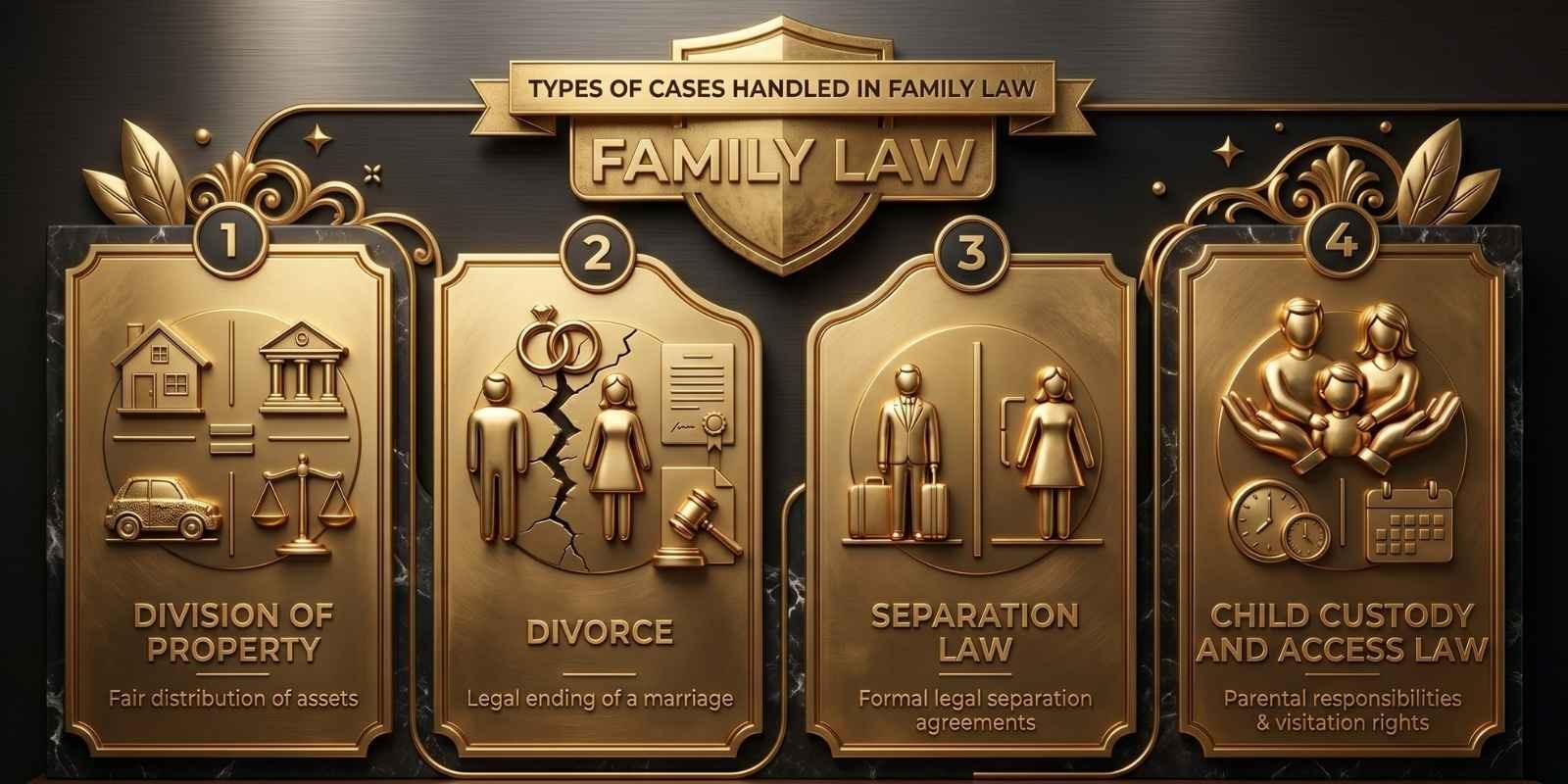
Family Law covers a wide range of legal disputes that arise within domestic relationships. These cases often require detailed legal attention due to their emotional and financial complexity.
Common family law cases include:
- Divorce and separation disputes
- Child custody and access disagreements
- Spousal and child support claims
- Property and asset distribution
- Prenuptial and separation agreements
Each case type involves different legal processes and outcomes depending on the family's circumstances.
For instance, divorce cases often include multiple overlapping legal issues such as custody, support, and property division. Legal professionals handling Divorce and Separation ensure that all aspects are addressed in compliance with Ontario family law.
How Family Law Impacts Everyday Life
Family law has a direct impact on everyday life decisions. It determines where children live, how financial responsibilities are shared, and how assets are divided after separation.
For parents, custody arrangements affect daily routines, education, and emotional stability of children. For spouses, support arrangements influence financial independence and long-term planning.
Even outside of disputes, family law plays a preventive role. Legal agreements created during marriage or cohabitation can help avoid future conflicts by clearly defining rights and responsibilities in advance.
Why Family Law Is Important in Modern Society
In modern society, Family Law plays a vital role in maintaining fairness, stability, and legal order within personal relationships. As family structures become more diverse and complex, the need for a clear legal system becomes even more important.
Family law ensures that disputes are resolved through structured legal processes rather than emotional decision-making, helping individuals protect their rights while minimizing conflict.
Protecting Legal Rights of Individuals and Families

One of the primary functions of Family Law is to protect the legal rights of all individuals involved in a family relationship. Without legal protection, one party may be disadvantaged during separation or divorce proceedings.
Family law ensures:
- Equal legal representation for both parties
- Protection of children’s best interests in custody matters
- Fair enforcement of financial responsibilities
For example, in custody disputes, courts prioritize the best interests of the child rather than personal conflict between parents. Similarly, financial support laws ensure that both spouses are treated fairly after separation.
Ensuring Fair Outcomes in Family Disputes
Family disputes are often emotionally charged, which can lead to unfair or impulsive decisions. Family Law provides a neutral legal framework that ensures decisions are based on evidence, legal principles, and fairness.
This is especially important in cases involving:
- Child custody and parenting time
- Spousal and child support
- Property and asset division
Through structured legal processes, courts aim to ensure balanced outcomes that protect the rights of both parties involved.
Legal assistance through Family Law services helps individuals prepare strong legal arguments and understand their rights clearly before entering negotiations or court proceedings.
Providing Legal Structure During Emotional Situations
Family breakdowns such as divorce or separation can be emotionally overwhelming. In such situations, individuals may struggle to make logical decisions regarding finances, custody, and legal responsibilities.
Family Law provides structure by:
- Establishing clear legal procedures
- Defining timelines for legal actions
- Ensuring proper documentation and evidence handling
- Encouraging mediation and dispute resolution
This structure reduces uncertainty and helps individuals move through legal processes in a more controlled and informed manner.
Understanding Divorce and Legal Separation
Divorce and legal separation are among the most significant aspects of family law. They involve the formal legal process of ending or restructuring a marital relationship.
Understanding this process is essential because it directly affects financial rights, custody arrangements, and long-term obligations.
Grounds for Divorce and Legal Requirements

In Canada, divorce is governed by federal law under the Divorce Act. The most common ground for divorce is marriage breakdown, which can be established in several ways:
- Living separately for at least one year
- Adultery
- Physical or mental cruelty
Before a divorce is granted, specific legal requirements must be met, including proper filing of documents and compliance with court procedures.
Legal support ensures that applications are correctly prepared and reduces the risk of delays or rejection.
The Divorce Process Step by Step
The divorce process in Ontario typically involves several structured steps:
- Filing a divorce application
- Serving documents to the other spouse
- Receiving a response or counterclaim
- Negotiation or mediation sessions
- Court hearings (if disputes remain unresolved)
- Final divorce order issued by the court
Each stage requires careful attention to legal detail to avoid complications or delays.
Many individuals seek professional help through Divorce and Separation services to ensure the process is handled efficiently and correctly.
Key Legal Issues in Divorce Proceedings
Divorce cases often involve more than just ending a marriage. They include several interconnected legal issues that must be resolved fairly.
Key issues include:
- Child custody and parenting arrangements
- Spousal support obligations
- Division of Property in Ontario
- Debt allocation between spouses
Each issue must be carefully assessed based on legal standards and financial circumstances.
For example, property division laws in Ontario aim to ensure equitable distribution of marital assets. Understanding the Division of Property is essential for ensuring fair financial outcomes after separation.
Child Custody Laws and Parental Rights
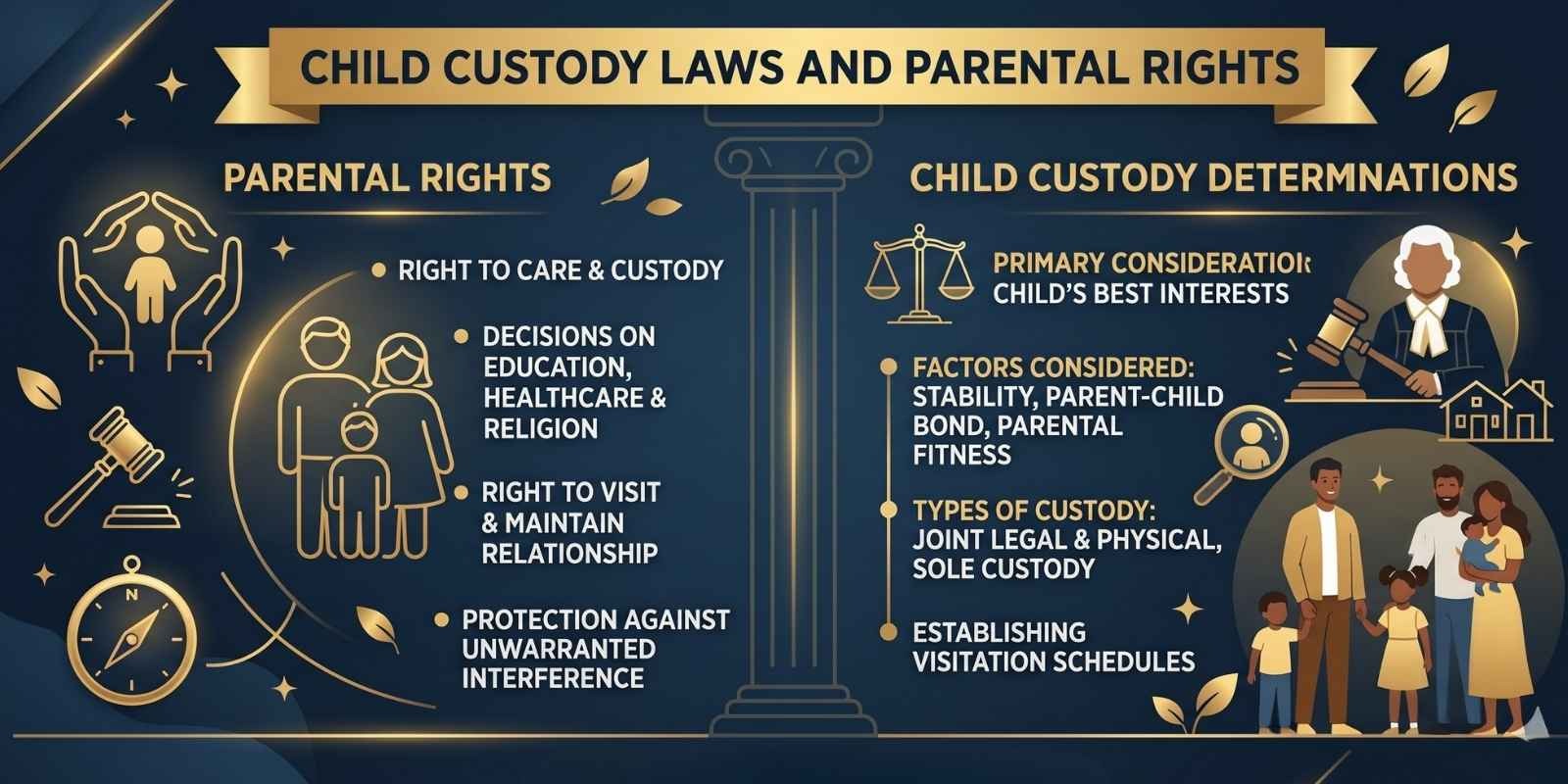
Child Custody laws are one of the most sensitive and important areas of Family Law. They determine how parents share responsibilities for raising their children after separation or divorce. These laws are designed to protect the best interests of the child while ensuring both parents maintain meaningful involvement in their child’s life whenever possible.
Custody disputes are handled carefully by courts, and legal support through custody and access is often essential for understanding rights and responsibilities clearly.
Types of Child Custody Arrangements
There are several types of child custody arrangements recognized under Canadian family law. Each arrangement depends on the family situation and what is most suitable for the child’s well-being.
The main types include:
- Sole custody, where one parent has full decision-making authority
- Joint custody, where both parents share decision-making responsibilities
- Shared custody, where the child spends significant time with both parents
- Split custody, where siblings may live with different parents
Each arrangement affects how major decisions are made regarding education, healthcare, and upbringing. Courts always aim to ensure that the arrangement promotes stability and emotional security for the child.
How Courts Determine the Best Interests of the Child
The concept of the best interests of the child is the foundation of all custody decisions in Ontario. Courts evaluate several factors before making a decision, including:
- The emotional bond between the child and each parent
- Stability of each home environment
- Ability of each parent to provide care
- Child’s preferences (depending on age and maturity)
- History of caregiving and involvement
The court’s priority is not the preference of either parent but what will best support the child’s development and long-term well-being.
Legal guidance is often recommended in these cases because presenting strong evidence and understanding court expectations can significantly impact the outcome.
Visitation Rights and Parenting Plans

Even when one parent does not have custody, they may still have visitation rights, also known as parenting time. These rights ensure that children maintain a healthy relationship with both parents.
A parenting plan is often created to clearly outline:
- Schedule of visits and holidays
- Decision-making responsibilities
- Communication methods between parents
- Rules regarding travel and relocation
Well-structured parenting plans help reduce conflict and provide consistency for the child. Courts encourage parents to agree on these arrangements whenever possible to avoid lengthy disputes.
Child and Spousal Support Explained
Financial support is a critical part of Family Law. It ensures that children and spouses receive the financial assistance they need after separation.
What Is Child Support and How Is It Calculated
Child support is a legal obligation that ensures both parents contribute financially to the upbringing of their children. It is usually paid by the non-custodial parent to the custodial parent.
In Ontario, child support is calculated based on:
- Income of the paying parent
- Number of children
- Federal child support guidelines
- Parenting time arrangements
The goal is to maintain a standard of living similar to what the child experienced before separation. Courts strictly enforce these payments to ensure children are financially supported.
Understanding Spousal Support and Eligibility
Spousal support is financial assistance paid by one spouse to the other after separation or divorce. It is not automatic and depends on several factors.
Eligibility is determined based on:
- Length of the relationship
- Financial disparity between spouses
- Roles during the marriage (e.g., caregiver vs breadwinner)
- Economic hardship caused by separation
Spousal support aims to reduce financial imbalance and help the receiving spouse become financially independent over time.
Each case is evaluated individually, and legal advice is often necessary to determine fair entitlement and obligations.
Enforcement and Modification of Support Orders

Once a support order is issued, it must be followed legally. If a party fails to comply, enforcement actions may be taken through the court system.
Support orders may also be modified if circumstances change, such as:
- Job loss or income change
- Changes in custody arrangements
- Remarriage or cohabitation
Legal assistance ensures that modifications are properly filed and justified under Ontario law. Courts require strong evidence before making any changes to existing support orders.
Division of Property and Financial Matters
One of the most complex aspects of Family Law is the division of assets and debts after separation or divorce. Financial matters often lead to disputes if not handled properly.
Marital vs. Non-Marital Property
In Ontario, property is generally classified into two categories:
- Marital property: Assets acquired during the marriage
- Non-marital property: Assets owned before marriage or received as gifts/inheritance
Understanding the difference is essential because only marital property is typically subject to division during divorce.
Legal guidance ensures proper classification of assets and prevents unfair financial outcomes.
How Assets and Debts Are Divided
The process of dividing assets and debts involves evaluating the total financial picture of both spouses. This includes:
- Real estate properties
- Bank accounts and savings
- Investments and pensions
- Loans and credit card debts
In many cases, assets are divided equally, but adjustments may be made depending on contributions and circumstances.
For example, real estate often plays a major role in division disputes, especially when property ownership is involved. In such cases, legal support similar to a Real Estate Lawyer may be relevant when evaluating property rights and ownership structures.
Protecting Financial Interests During Divorce

Protecting financial interests is a critical part of any separation process. Without proper legal guidance, individuals may lose access to assets or take on unfair financial burdens.
Key steps to protect financial interests include:
- Full financial disclosure from both parties
- Proper valuation of assets
- Legal review of agreements before signing
- Ensuring debts are fairly allocated
In more complex situations, legal professionals may also identify issues related to financial misconduct or hidden assets, ensuring transparency during proceedings.
If financial disputes escalate significantly, they may sometimes intersect with broader legal concerns requiring support from professionals, such as a Criminal Lawyer, in rare cases involving fraud or misconduct.
Common Family Law Disputes and How They Are Resolved
Family disputes are common during separation or divorce, and Family Law provides structured methods for resolving them. These disputes often involve emotional and financial stress, making legal intervention important.
Custody Conflicts and Disagreements
Custody conflicts arise when parents cannot agree on who should care for the child or how parenting time should be shared. These disputes are often resolved through:
- Mediation
- Negotiation between lawyers
- Court intervention if necessary
Courts always prioritize the best interests of the child, focusing on stability and emotional well-being rather than parental preference.
Financial Disputes Between Spouses
Financial disputes are among the most common issues in family law cases. These may involve disagreements over:
- Property division
- Spousal support amounts
- Hidden assets or income
- Debt responsibility
Such disputes require careful financial analysis and legal negotiation to ensure fairness. Proper documentation and legal representation play a key role in achieving a resolution.
Role of Negotiation, Mediation, and Litigation
There are three main ways to resolve family law disputes:
Negotiation allows both parties to reach an agreement privately with legal guidance.
Mediation involves a neutral third party helping both sides reach a fair solution.
Litigation involves court proceedings where a judge makes the final decision.
Most family law cases are resolved outside of court through negotiation or mediation, as these methods are less stressful and more cost-effective. However, litigation is sometimes necessary in highly contested disputes.
The Role of a Family Law Lawyer

A Family Law Lawyer plays a critical role in guiding individuals through some of the most complex and emotional legal matters. Whether it involves divorce, child custody, support disputes, or property division, a lawyer ensures that your rights are protected and that every step of the legal process is handled correctly under Ontario law.
Legal representation becomes especially important in high-conflict cases where emotions can cloud judgment and legal mistakes can have long-term consequences.
Legal support is also available in specific regions where clients need localized assistance, helping individuals handle both negotiations and court matters with proper legal guidance.
Legal Advice and Case Strategy
One of the most important responsibilities of a Family Law Lawyer is providing clear and strategic legal advice. Every family law case is different, and a strong strategy is essential to achieve a fair outcome.
A lawyer helps clients understand:
- Their legal rights and obligations
- Strengths and weaknesses of their case
- Possible outcomes in court
- Best negotiation strategies
This legal strategy is especially important in disputes involving child custody, spousal support, or complex financial matters. Without proper guidance, individuals may agree to unfavorable terms that can impact them for years. In some cases, family matters may connect with areas like immigration, particularly where international spouses or residency status becomes part of the legal situation.
Document Preparation and Court Representation
Family law cases require extensive documentation, including financial records, custody agreements, affidavits, and legal applications. A Family Law Lawyer ensures that all documents are properly prepared, accurate, and submitted within legal deadlines.
Key responsibilities include:
- Drafting legal applications and responses
- Preparing evidence for court hearings
- Reviewing financial disclosures
- Filing agreements with the court
Incorrect or incomplete documentation can delay a case or negatively affect its outcome. Lawyers also ensure compliance with Ontario court procedures, which can be complex for individuals without legal training.
In cases involving property disputes, legal professionals may also work alongside experts familiar with real estate transactions, especially when dealing with asset transfers or property sales similar to Purchase and Sale agreements.
Protecting Your Rights Throughout the Process

A major role of a Family Law Lawyer is to protect your legal rights at every stage of the process. From the initial consultation to final settlement or court judgment, the lawyer ensures that you are treated fairly under the law.
This includes:
- Preventing unfair agreements
- Ensuring proper disclosure from the other party
- Protecting parental rights in custody cases
- Securing fair financial outcomes
Without legal representation, individuals may feel pressured into agreements that are not in their best interest. A lawyer acts as both an advocate and a safeguard during negotiations and court proceedings.
Risks of Handling Family Law Matters Without Legal Help
Handling family law matters without professional legal support can lead to serious mistakes. While some individuals attempt to manage their cases independently, the complexity of Family Law often results in unfavorable outcomes.
Legal Mistakes That Can Affect Your Case
One of the biggest risks of self-representation is making legal mistakes that can significantly impact your case. These mistakes may include:
- Missing court deadlines
- Filing incorrect documents
- Misunderstanding legal rights
- Accepting unfair settlement terms
Even small errors can delay proceedings or reduce your chances of a favorable outcome. Family law involves strict legal procedures, and courts expect full compliance with documentation and evidence rules.
Financial and Emotional Consequences
Family law disputes are already emotionally challenging, and without legal guidance, the stress can increase significantly. Financial consequences can also be severe.
Potential risks include:
- Losing access to fair property division
- Agreeing to unfair support payments
- Increased legal costs due to delays
- Financial instability after settlement
Emotional stress is also common when individuals face court proceedings alone. Legal support helps reduce uncertainty and provides clarity during difficult decisions.
Long-Term Impact on Your Rights and Obligations
Decisions made during family law proceedings can have long-term consequences. Once agreements are finalized or court orders are issued, they are often difficult to change.
Without proper legal advice, individuals may:
- Lose custody or parenting rights
- Agree to unfair financial obligations
- Miss opportunities for legal adjustments
- Face enforcement actions for non-compliance
Because of these long-term effects, legal representation is essential in ensuring that decisions made today do not negatively impact your future.
How to Choose the Right Family Law Lawyer
Selecting the right Family Law Lawyer is one of the most important decisions in any legal case. The right lawyer can significantly improve your chances of achieving a fair and efficient outcome.
Experience and Area of Focus
Experience is a key factor when choosing a lawyer. A lawyer who specializes in Family Law will have a deeper understanding of custody disputes, support calculations, and property division laws.
Important factors to consider include:
- Years of experience in family law
- Track record in similar cases
- Knowledge of Ontario family law regulations
- Experience with court representation
Choosing a lawyer with a strong background ensures better case preparation and legal strategy.
Communication and Client Support
Effective communication is essential in legal cases. A good Family Law Lawyer should be able to explain complex legal issues simply and clearly.
Look for:
- Regular updates on your case
- Clear explanation of legal options
- Availability for questions and concerns
- Transparent communication about costs
Strong client support helps reduce stress and ensures that you remain informed throughout the legal process.
Questions to Ask Before Hiring a Lawyer
Before hiring a lawyer, it is important to ask the right questions to understand their approach and expertise.
Key questions include:
- What is your experience in family law cases?
- How do you approach custody or support disputes?
- What is your expected timeline for cases like mine?
- How are legal fees structured?
These questions help you assess whether the lawyer is the right fit for your specific situation.
When You Should Seek Legal Help in Family Law Matters
Knowing when to seek legal help is crucial in avoiding complications in Family Law cases. Early legal intervention can often prevent disputes from escalating.
Early Legal Advice and Its Benefits
Seeking legal advice early in a family matter can significantly improve outcomes. Early intervention allows for:
- Better preparation of legal documents
- Stronger negotiation positions
- Prevention of costly mistakes
- Faster resolution of disputes
Early legal planning is especially helpful in separation cases where financial and custody arrangements must be clearly defined.
Situations That Require Immediate Legal Attention

Certain situations require urgent legal assistance, including:
- Child custody disputes or relocation issues
- Domestic conflict or restraining concerns
- Property disputes involving high-value assets
- Disagreements over support payments
In such cases, immediate legal action ensures your rights are protected and prevents irreversible decisions from being made without proper guidance.
Planning to Avoid Legal Issues
Proactive legal planning can help prevent many family law disputes. This includes:
- Drafting prenuptial or separation agreements
- Establishing clear parenting plans
- Documenting financial arrangements
- Understanding legal rights before marriage or separation
Planning reduces uncertainty and helps families avoid unnecessary conflict in the future.
Understanding Your Rights and Taking the Right Legal Steps
Family law plays a vital role in protecting individuals and families during some of life’s most challenging moments. Whether you are dealing with divorce, child custody, financial support, or property division, understanding your legal rights is essential for achieving a fair and stable outcome.
Attempting to handle these matters without legal assistance can lead to mistakes, financial loss, and long-term consequences that are difficult to reverse. On the other hand, working with a qualified family law lawyer provides the guidance, support, and expertise needed to navigate the legal process effectively.
Choosing the right lawyer, seeking advice early, and taking proactive steps can make a significant difference in the outcome of your case. By approaching family law matters with the right legal strategy, you can protect your rights, reduce stress, and move forward with confidence.
Ultimately, the key to success in family law is being informed, prepared, and supported. Taking the right legal steps ensures that you are not only addressing current challenges but also securing a stable and positive future.